 Pinellas County, FL
Reverse Osmosis Drinking Water
A dedicated drinking-water tap for your kitchen — installed under your sink, built from quality components. Installed and serviced by the owner across Pinellas County and the Tampa Bay area.
Make your choices.
Everything for this kind of water, in one place. Pick a system, see the rough price, sign up for service, or read up first — in whatever order suits you.
Pick your system
RO at the tap, installed and serviced
Under-sink reverse osmosis — installed, serviced, and taught to you, not just dropped off in a box.
Start an install or service request →See your rough price
Priced in your written quote
Drinking-water worry is handled at the tap by an under-sink reverse-osmosis unit, priced in the same written quote after the free test — no invented sticker price here.
Run the estimator →Sign up for service
Filter changes & service calls
A service call is a flat $149. Care plans cover the annual check and keep your warranty valid — Essential $39/month or $399/year, Plus $69/month.
Book a service call →Read up first
How RO works & the record card
What reverse osmosis does — and doesn’t — fix, how your install-day readings and red-line number work, and the printable record & care guide that goes home with you.
Start reading →What reverse osmosis actually does
A reverse osmosis membrane pushes water through a semi-permeable barrier that rejects the vast majority of dissolved solids — including lead, fluoride, chlorine and chloramine tastes and odors, and, per manufacturer test data, many PFAS compounds. The result is clean, great-tasting water at your own kitchen tap for drinking, cooking, and ice.
On install day I take two dissolved-solids readings — your tap water, and the water coming out of the RO tap — and both numbers go on the record card that goes home with you, so you have a starting point to compare against at every filter change.
What RO does — and doesn't — fix
It does reduce
- Dissolved solids (TDS)
- Lead and many dissolved metals
- Fluoride
- Chlorine and chloramine tastes and odors
- Many PFAS compounds (per membrane manufacturer test data)
It doesn't
- Fix hard water — that's the softener's job (calcium and magnesium shorten membrane life)
- Disinfect water that isn't microbiologically safe — that needs UV or another disinfection step first
- Remove every single contaminant — the free test tells you what your water actually needs
Good to know
- RO is a point-of-use system — drinking, cooking, and ice, not the whole house
- Needs normal household water pressure to perform (a booster can be added when it doesn't)
- Filter life depends on your water — changes follow the maker's schedule for your system
Install and service, not just a box
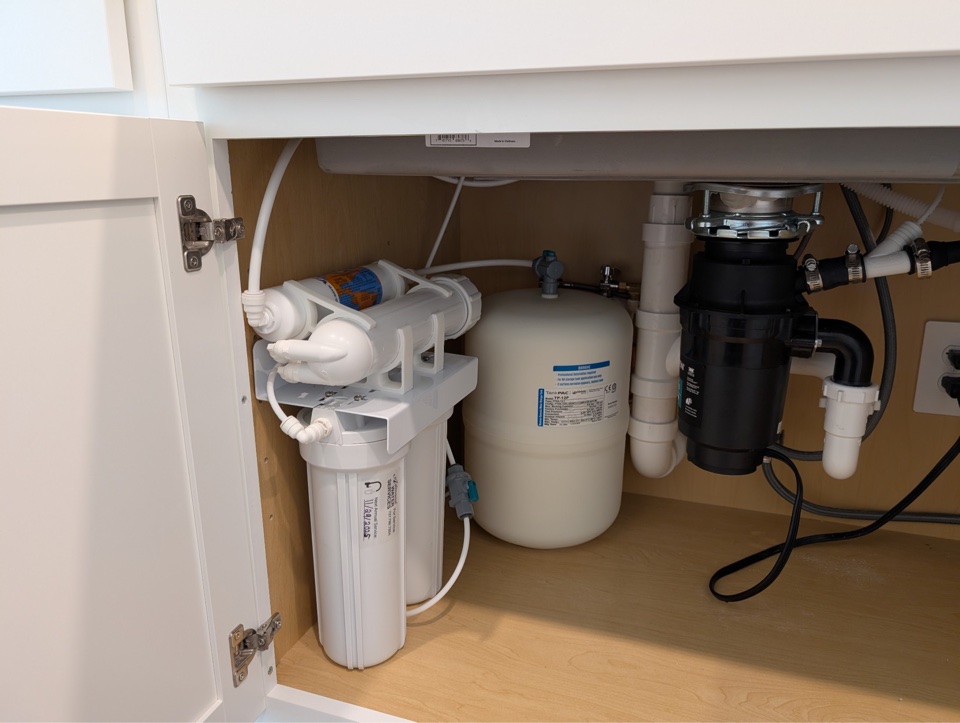
I install under-sink RO systems in Pinellas County homes — a proper install with a clean faucet on the sink, a tidy under-sink layout. And I service them too: filter changes, membrane checks, and troubleshooting when something isn't right. If you already have an RO unit that's slow, noisy, or producing bad-tasting water, I'll tell you whether it's worth fixing or replacing.
If your water tests show you need softening too, I'll say so straight — running hard water through an RO membrane without a softener just eats membranes. The free test sorts that out before you spend a dollar.
How to read the TDS number
When I test your water, I take a total dissolved solids (TDS) reading. That number is the total amount of dissolved stuff in the water — minerals, salts, and the rest — measured in parts per million (ppm), which is the same as milligrams per liter (mg/L). A number by itself does not tell you much. Here is the scale I use when I stand at a customer's sink.
The United States Environmental Protection Agency (EPA) sets a secondary guideline for total dissolved solids of 500 milligrams per liter. Secondary means it is not an enforceable health limit — it is a taste-and-nuisance guideline. The EPA lists the effects above it as hardness, deposits, colored water, staining, and salty taste, and the agency names reverse osmosis as an effective way to bring total dissolved solids down. Under 500 is not a clean bill of health, and over 500 is not a violation. It is a line for taste and deposits, nothing more.
Pinellas County Utilities, in its own 2025 report, put total dissolved solids at an average of 343 parts per million, with samples ranging from 293 to 392 — about 69 percent of that 500 guideline, at the tap, before any filter. The City of Tampa did not publish a total dissolved solids number in its 2025 report at all. That gap is exactly why a reading at your own tap matters more than a county average.
At your install I take two readings: your tap water, and the water coming out of the reverse osmosis tap. The math is plain. If your tap reads 343 and the drinking-water tap reads 34, the system took out 309 of those 343 parts — about 90 percent. That is an arithmetic example using the Pinellas average, not a promise for your house. Your two numbers, taken at your sink on install day, are the ones that count, and I write them down so you have a starting point.
One honest limit: a TDS reading tells you how much dissolved stuff there is in total. It does not tell you what that stuff is. A low number does not name what was removed, and a high number does not name what is in there. That is what the free test and, when it is called for, a certified lab test are for. What the number does well is change over time — when a reading taken at a service visit climbs up from where it sat on install day, the membrane or the filters need attention.
Sources
- United States Environmental Protection Agency — Secondary Drinking Water Standards: Guidance for Nuisance Chemicals (total dissolved solids guideline: 500 mg/L)
- Pinellas County 2025 water quality report (total dissolved solids: 343 ppm average, range 293–392 ppm)
- City of Tampa 2025 water quality report (published 2026; no total dissolved solids figure published)
The record goes home with you — on paper
The section above ends with a promise: your two install-day numbers get written down. This is the paper they go on. The Reverse Osmosis Record & Care Guide is a printable sheet that lives under your sink: your system's fill-in record, your personal red-line number — the TDS level where the membrane is done, worked out from the maker's own 75-percent rule — the maker's change schedule for every filter, the check-in-this-order list for slow or bad-tasting water, the restart note for a house that sat empty, and a service log that turns those readings into proof.
Print it, fill it in with me at the install, and keep it at the unit. Already have a reverse osmosis system — mine or anyone's? The same sheet works: take your two readings today, work out your red line, and you have a starting point from now on.
Drinking-water questions, straight answers.
Does reverse osmosis remove PFAS?
Many RO membranes are tested to reduce several PFAS compounds significantly, per manufacturer test data. Reduction depends on the membrane and the compound — I don't promise "PFAS-free" on a guess. If PFAS is your concern, I sell a certified lab PFAS test and walk you through the results before recommending anything.
Will I know when to change the filters?
Yes — your filters follow the maker's change schedule for your system, and your install-day dissolved-solids reading is written on your record card. When I re-check that number at a service visit and it has climbed, the membrane or filters need attention.
Do I need a softener too?
Not necessarily — the free test decides. But if your water is hard, an RO membrane will foul early without softening first. I'd rather tell you that upfront than sell you membranes twice a year.
Do you service systems you didn't install?
Yes. If your existing RO is slow, noisy, or the water tastes off, I'll diagnose it — filter changes, membrane checks, and full troubleshooting. If it's not worth fixing, I'll tell you that too.
How does the free test work?
I come to your house, test your water at the tap — about 20 minutes, results on the spot in plain English, zero obligation. You keep the results whether you buy from me or not.
Start with the free test.
Twenty minutes at your tap, results in plain English, and a clear answer on whether a drinking-water system makes sense for your home.